The sums get harder in secondary school, but the trouble is the same as in primary: the question turns up as a paragraph, and the student has to turn it into maths.
Knowing the method is not enough
A Tingkatan 3 student can often solve a quadratic equation, or use Pythagoras' theorem, when it is written out as an equation. Give them the same idea as a paragraph about a ladder, a bank deposit or two trains, and many cannot get started. They know the method. They just cannot tell which one the story needs.
Secondary exams lean on this. Long questions are built around a situation, and the marks go to whoever can set it up. That skill is often called modelling, and it can be practised like any other.
Turning a sentence into an equation
- Draw it or list it. A quick sketch, a table or a short list of "what I know" turns a paragraph into something you can look at.
- Name the unknown. Write "let the price of a book be b" before anything else.
- Match the topic. Is it a right-angled triangle, a pair of equations, a ratio, a bearing? The topic tells you which tool to pick up.
- Write the equation, then solve it. Keep the setting up and the solving on separate lines.
- Check it against the story. A length cannot be negative, and a price should come out in sensible ringgit and sen.
Tingkatan 3, Pythagoras. A 5 m ladder leans against a wall with its foot 3 m from the wall. How high up the wall does it reach? The ladder is the longest side, so h² + 3² = 5², which gives h² = 25 − 9 = 16, and h = 4 m.
Tingkatan 4, simultaneous equations. 2 pens and 3 books cost RM17. 1 pen and 2 books cost RM10.50. What is the price of one book? Let a pen cost p and a book b. Then 2p + 3b = 17 and p + 2b = 10.5. Double the second one to get 2p + 4b = 21. Subtract the first and b = RM4. Check: p = 2.50, and 5 + 12 = 17.
250 worksheets, five years
Mathhh has a topic called Problem Solving (Secondary 1-5): 250 worksheets for Tingkatan 1 to 5, or 50 a year. Each year has ten topics of five worksheets, ordered from easier to harder. Roughly, this is what each year covers:
- Tingkatan 1: integers, factors and multiples, ratios and rates, linear equations and inequalities, perimeter and area.
- Tingkatan 2: patterns and sequences, expansion and factorisation, circles, coordinates, straight-line graphs, speed, distance and time.
- Tingkatan 3: indices, standard form, consumer mathematics, Pythagoras' theorem, trigonometric ratios, angles of elevation and depression, quadratic equations.
- Tingkatan 4: quadratic functions, sets and Venn diagrams, simultaneous equations, graphs of motion, measures of dispersion, financial management and multi-step modelling.
- Tingkatan 5: variation, matrices, insurance and taxation, bearings, the sine and cosine rules, lines and planes in three dimensions, linear programming and mathematical modelling.
How a worksheet works
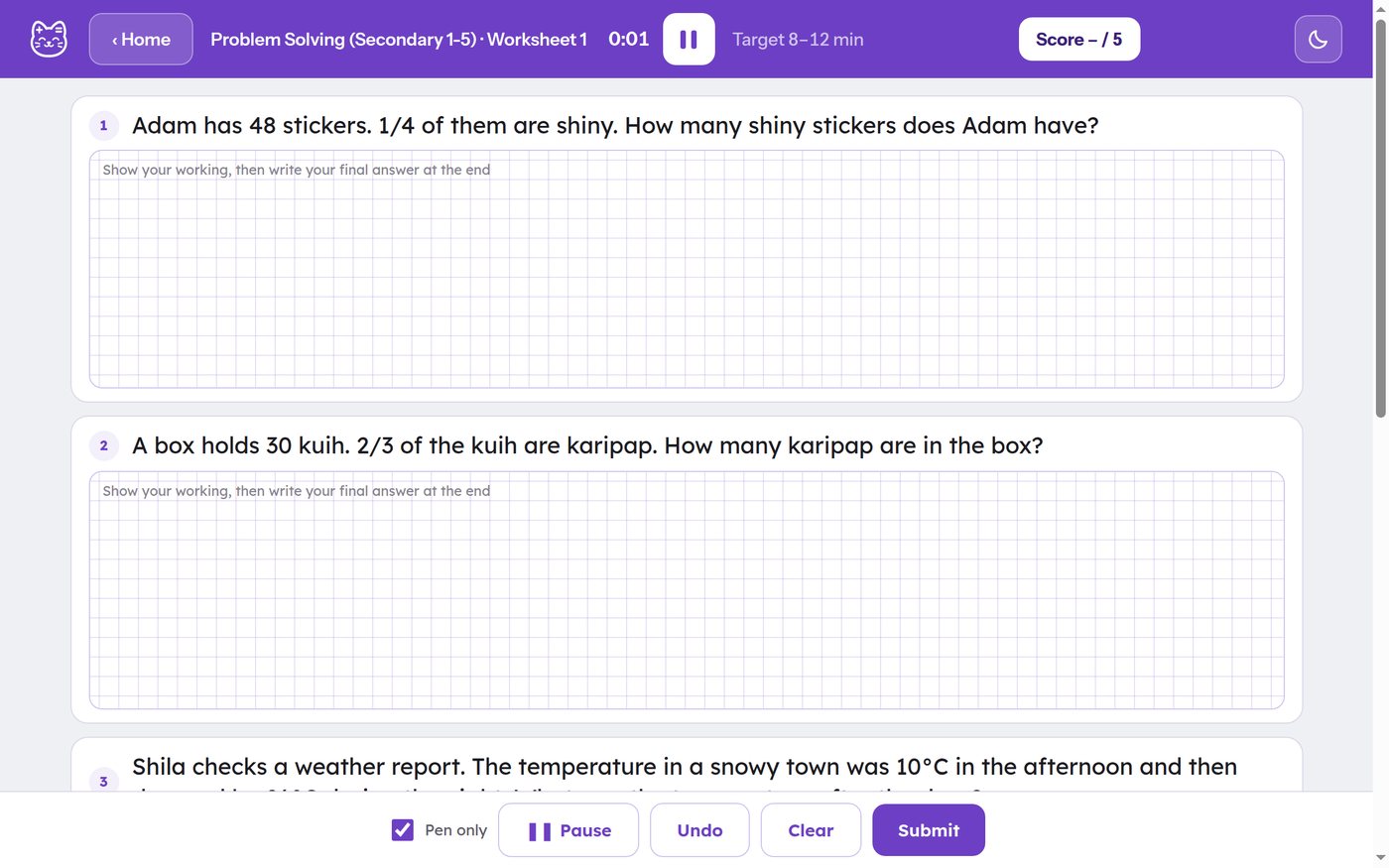
- Each worksheet has five questions with one number as the answer. Where rounding matters, the question says so, for example "correct to 1 decimal place".
- Students show their working in the tall squared box and put the final answer at the end, the way they would in an exam.
- Only the final answer is marked. Mathhh reads the last answer and ignores the working and the units.
- If an answer is wrong, the steps to solve it are shown, so the student can compare their method with the right one.
- The pass mark is 90%, which with five questions means all five. Below that, correct only the wrong ones and hand in again.
Fitting it into revision
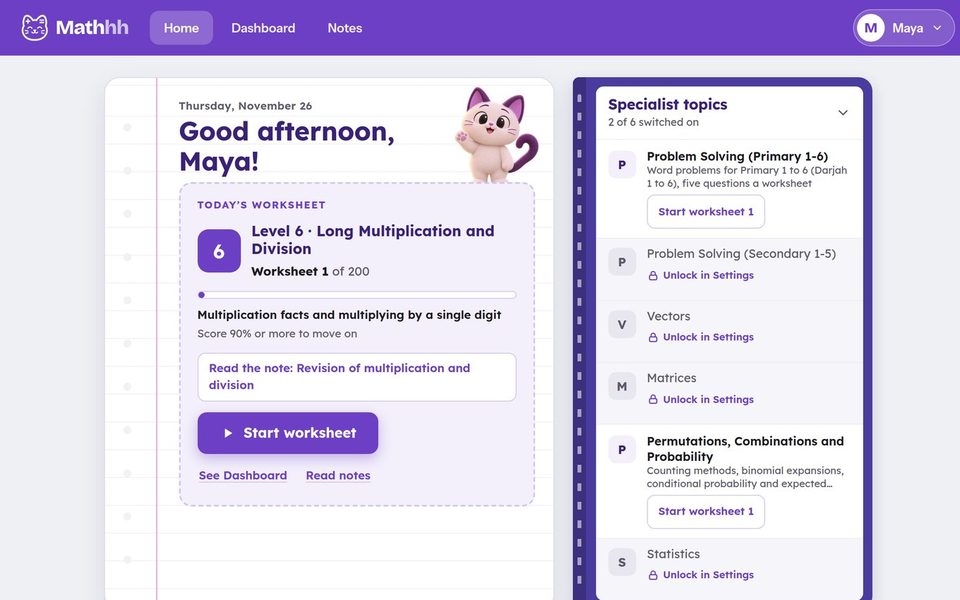
It is open from the start, so there is nothing to switch on. On Home it has its own orange card, with a map of the student's current school year and its own Start worksheet button. It never moves the student's place on the 17 levels. One way to use it is the daily worksheet for fluency, plus a Problem Solving sheet two or three times a week on whatever the class is covering at school. The boxes are tall, so students get used to setting their work out the way an exam paper expects.
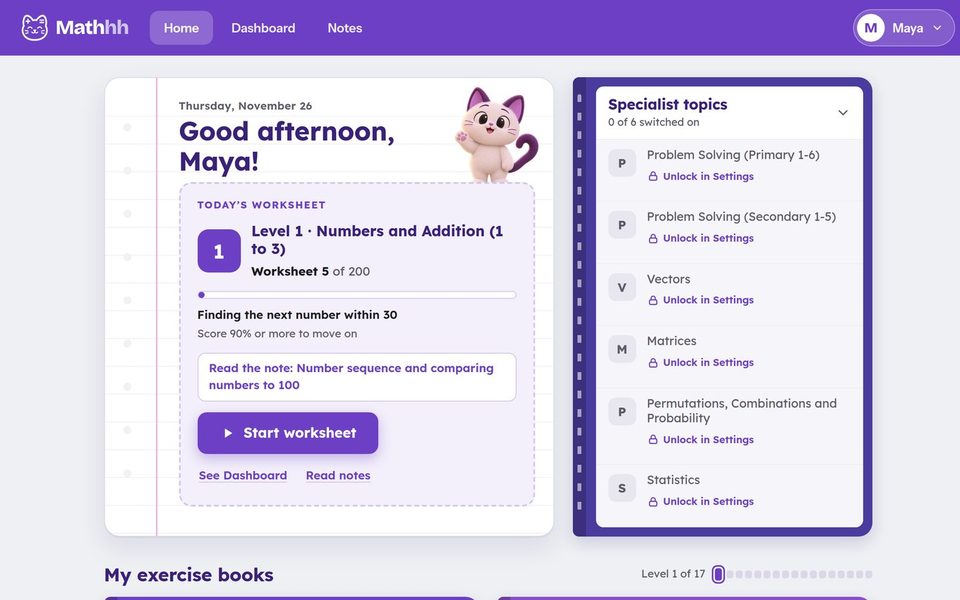
Younger students can start with the Primary track. Vectors, Matrices, Probability and Statistics are covered in advanced topics.
Questions people ask
Why do secondary students struggle with word problems?
They often know the method but cannot tell which one a story needs. Turning a paragraph into an equation, which is called modelling, is a separate skill and needs its own practice.
How do you turn a word problem into an equation?
Draw it or list what you know, name the unknown, match the situation to a topic, write the equation, solve it and check the answer against the story.
How many Problem Solving worksheets are there for Secondary?
250 worksheets for Secondary 1 to 5 (Tingkatan 1 to 5): 50 for each year, in ten topics of five worksheets.
Which topics do the Secondary worksheets cover?
They follow the school years, from integers and linear equations in Tingkatan 1 to bearings, the sine and cosine rules, linear programming and mathematical modelling in Tingkatan 5.
How are Secondary Problem Solving worksheets marked?
The student writes the working in a tall box and the final answer at the end. Mathhh marks only the final answer, using the rounding stated in the question, and shows how to solve any that were wrong.