The 17 levels are the main course. Advanced topics are extra sets of worksheets, all open from the start, for when you want to practise something in particular.
What are advanced topics?
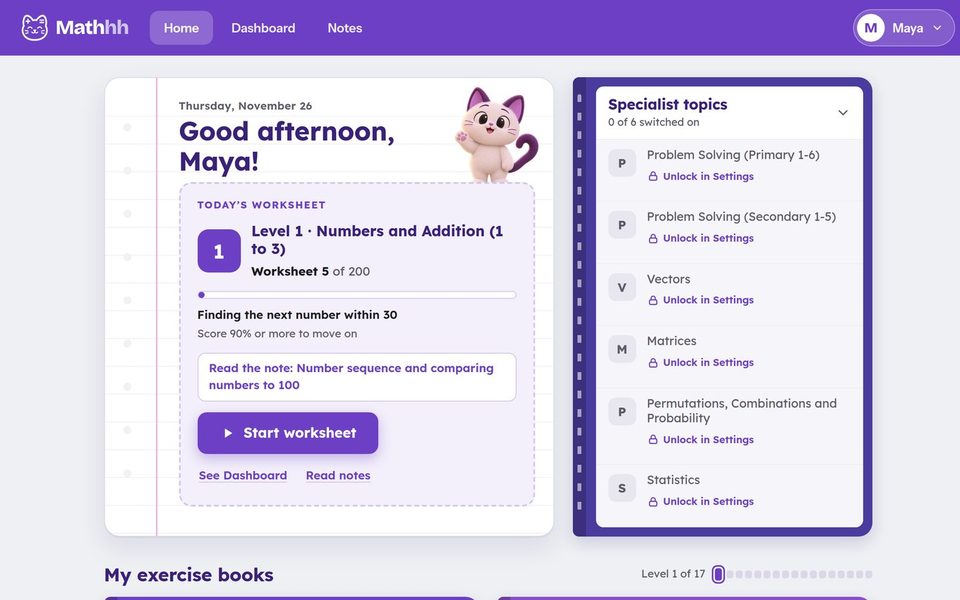
A advanced topic is a set of worksheets that sits beside the 17 levels rather than inside them. It has its own worksheets, its own place and its own Start worksheet button. Working on one never changes your main level, so you can try a topic without losing your place.
There are four: Vectors, Matrices, Permutations, Combinations and Probability, and Statistics. Between them they hold 390 worksheets. Problem Solving is not one of them: its 550 worksheets (300 for Primary 1 to 6 and 250 for Secondary 1 to 5) have their own orange card on Home. Add the 3,400 on the main ladder and that is 4,340 worksheets in all.
All open from the start
No topic is locked behind a level, and there is nothing to switch on. On Home, under your level and Problem Solving, a Advanced topics list shows the four topics, all folded away. Tap one to open its map and its own coloured Start worksheet button. Your place in each topic is kept.
Opening one topic folds the others, so Home stays calm until you want a topic.
Problem Solving: word problems
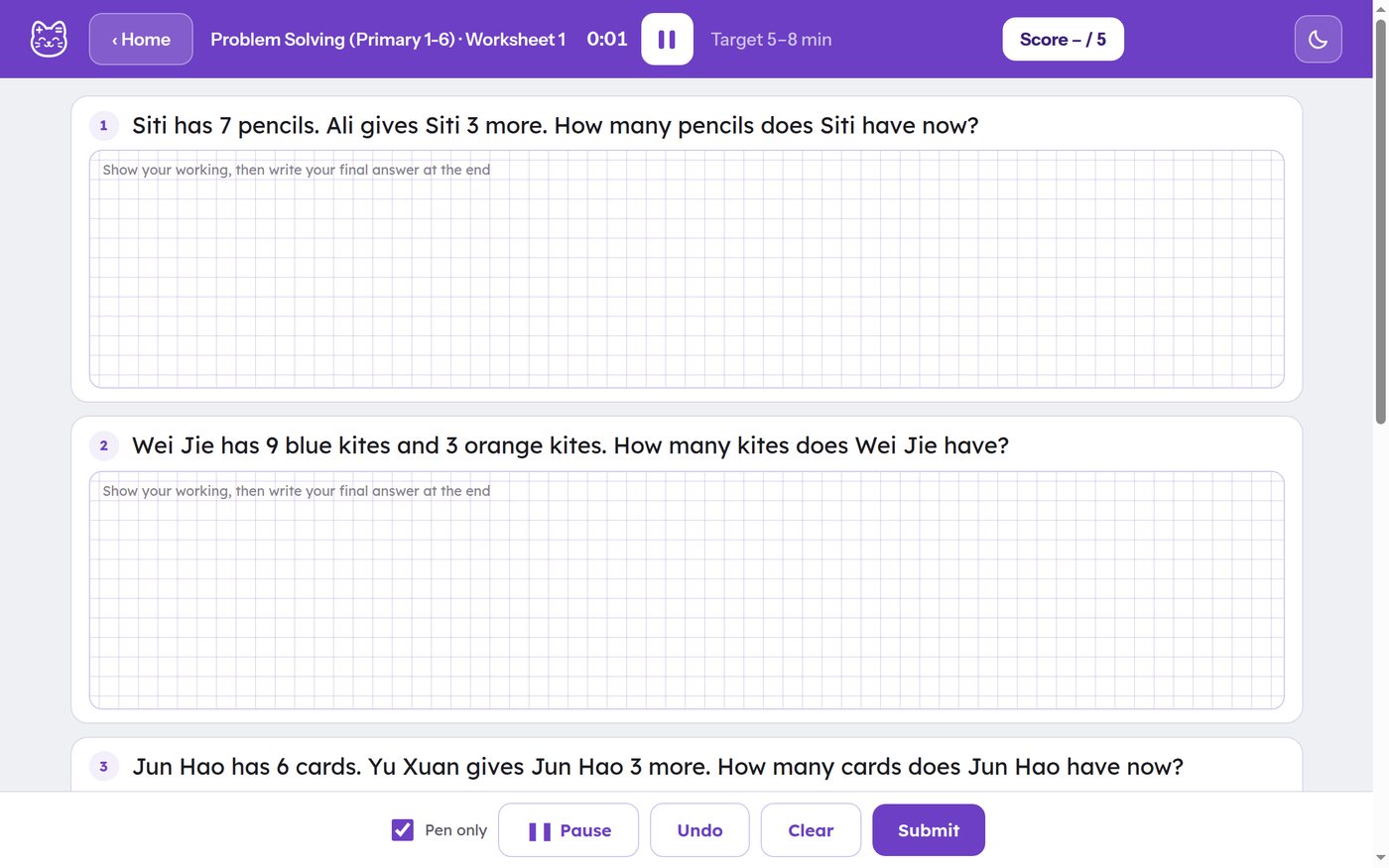
The two newest topics are about word problems: reading the problem, working out what to do and writing down the steps. Problem Solving (Primary 1-6) has 300 worksheets for Darjah 1 to 6, and Problem Solving (Secondary 1-5) has 250 for Tingkatan 1 to 5. Each year has ten topics, and every worksheet shows its year and topic.
- Each worksheet has five questions, each a short real-life problem with one number as the answer.
- Every question has a tall squared box. Write your steps in it, then the final answer at the end.
- Only the final answer is marked. Mathhh reads the last answer and ignores the working and any units.
- If an answer is wrong, a short list of steps shows how to solve it.
Each track has its own guide: word problems for Primary 1 to 6 and word problems for Secondary 1 to 5.
Vectors, Matrices, Probability and Statistics
The other four topics are for students who want to go beyond the main levels:
- Vectors: 140 worksheets on plane and space vectors, the dot product, lines, planes and spheres.
- Matrices: 90 worksheets on matrix arithmetic, inverses and linear transformations.
- Permutations, Combinations and Probability: 90 worksheets on counting methods, binomial expansions, conditional probability and expected value.
- Statistics: 70 worksheets on averages, binomial and normal distributions, estimation and hypothesis tests.
Which should you try?
Students in the Algebra levels could try Probability, and students reaching Calculus and beyond may like Vectors, Matrices and Statistics. Problem Solving has its own card on Home. We would keep the main worksheet as the daily one and treat a topic as an extra.
The main course is still the 17 levels. Advanced topics work like the rest of Mathhh: you write by hand, score 90% to move on, and correct only the wrong answers.
Questions people ask
What are advanced topics in Mathhh?
Separate tracks of worksheets that sit beside the 17 levels: Vectors, Matrices, Permutations Combinations and Probability, and Statistics. Problem Solving has its own card on Home.
How do I open a advanced topic?
On Home, under your level and Problem Solving, tap the topic in the Advanced topics list. Its map and Start worksheet button open. There is nothing to switch on.
Do advanced topics change my main level?
No. Each track keeps its own current worksheet, so your place on the 17 levels does not move.
Is my place in a topic kept?
Yes. Each topic keeps its own current worksheet, so you carry on where you stopped.
How many worksheets are in the advanced topics?
390: Vectors 140, Matrices 90, Probability 90 and Statistics 70. Problem Solving adds 550 (Primary 300 and Secondary 250), with its own card on Home. With the 3,400 on the main ladder that makes 4,340.
How are Problem Solving worksheets marked?
Each has five word problems. You show your working in a large box and write the final answer at the end; Mathhh marks only that final answer, and shows how to solve any you got wrong.