Ask a child to work out 24 - 9 and they will usually get it. Put the same sum in a story about stickers and a brother, and a lot of them stall. The arithmetic has not changed. The reading has.
The sum is not usually the problem
Most teachers and parents have seen this. A child gets through a page of plain sums with no trouble, then freezes on a page of word problems. They guess an operation, add the first two numbers they spot, or leave the box empty.
A word problem asks for three things in order: follow the story, decide what to do, then calculate. Children have practised the last one the most, so that is rarely where they go wrong.
Why a sentence is harder than a sum
- A sum shows you the plus or the minus. A story says "gives away" or "how many are left", and the child has to turn that into an operation.
- From Darjah 3, many problems take two or three steps. A child who stops after the first one ends up with a wrong answer that looks perfectly sensible.
- Real problems often carry extra facts, and a child who uses every number in the story will go wrong.
- Wording about size and order is easy to flip. "5 more than Ali" and "5 times as many as Ali" sound alike to a child, but they need different sums.
- Few children are asked to explain their thinking. If the working never reaches the page, nobody can find the mistake in the middle.
A method a child can follow
It helps to use the same few steps every time, so a child does not have to invent a plan while they are nervous.
- Read it twice. Once to follow the story, and once to pick out the numbers.
- Find the question. Underline what it is asking. It is usually in the last sentence.
- Say what happens. "She had some, gave some away, then got some more." Put it in your own words before you touch the numbers.
- Write each step on its own line. One line for each thing you work out.
- Check the answer against the story. Does 30 stickers make sense for someone who started with 24?
Siti buys 4 notebooks at RM3.50 each and pays with a RM20 note. How much change does she get?
The notebooks cost 4 × 3.50 = RM14.00. The change is 20 − 14 = RM6. That is two steps, one line each. If a child writes only "20 − 3.50", they have used the wrong numbers, and the written line shows exactly where it went wrong.
Practice that follows the school year
Mathhh has a topic called Problem Solving (Primary 1-6): 300 worksheets, 50 for each Darjah. Every year is split into ten topics of five worksheets each, and the questions get a little harder as you work through a topic.
The topics follow what each year teaches. Darjah 1 starts with adding and taking away within 20, then moves on to money in sen and ringgit and stories with two steps. Darjah 4 covers fractions, decimals, converting length, mass and volume, and perimeter, area and volume. By Darjah 6 you will find ratio, rate and speed, percentages, circles, working backwards and some challenge problems.
How a worksheet works
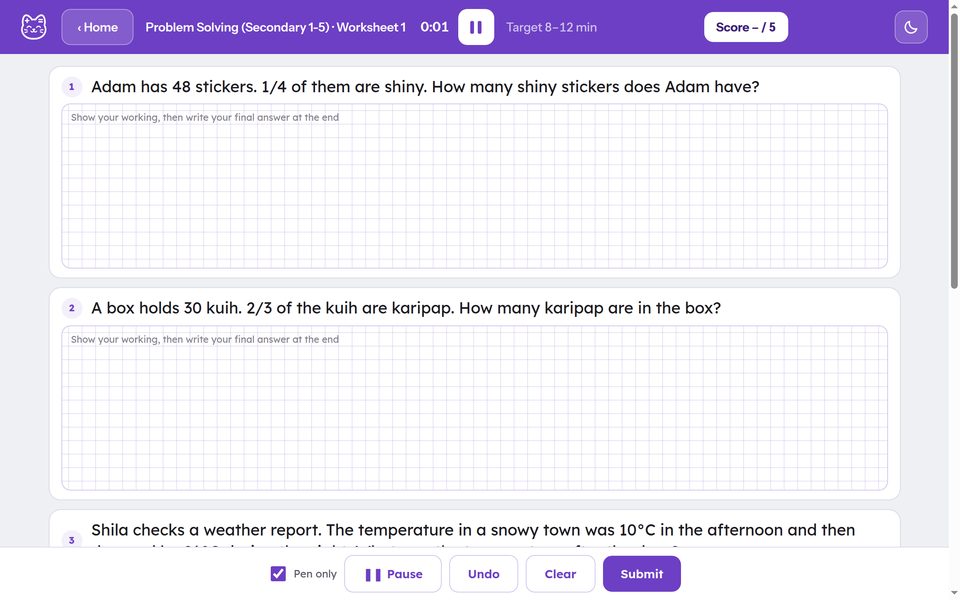
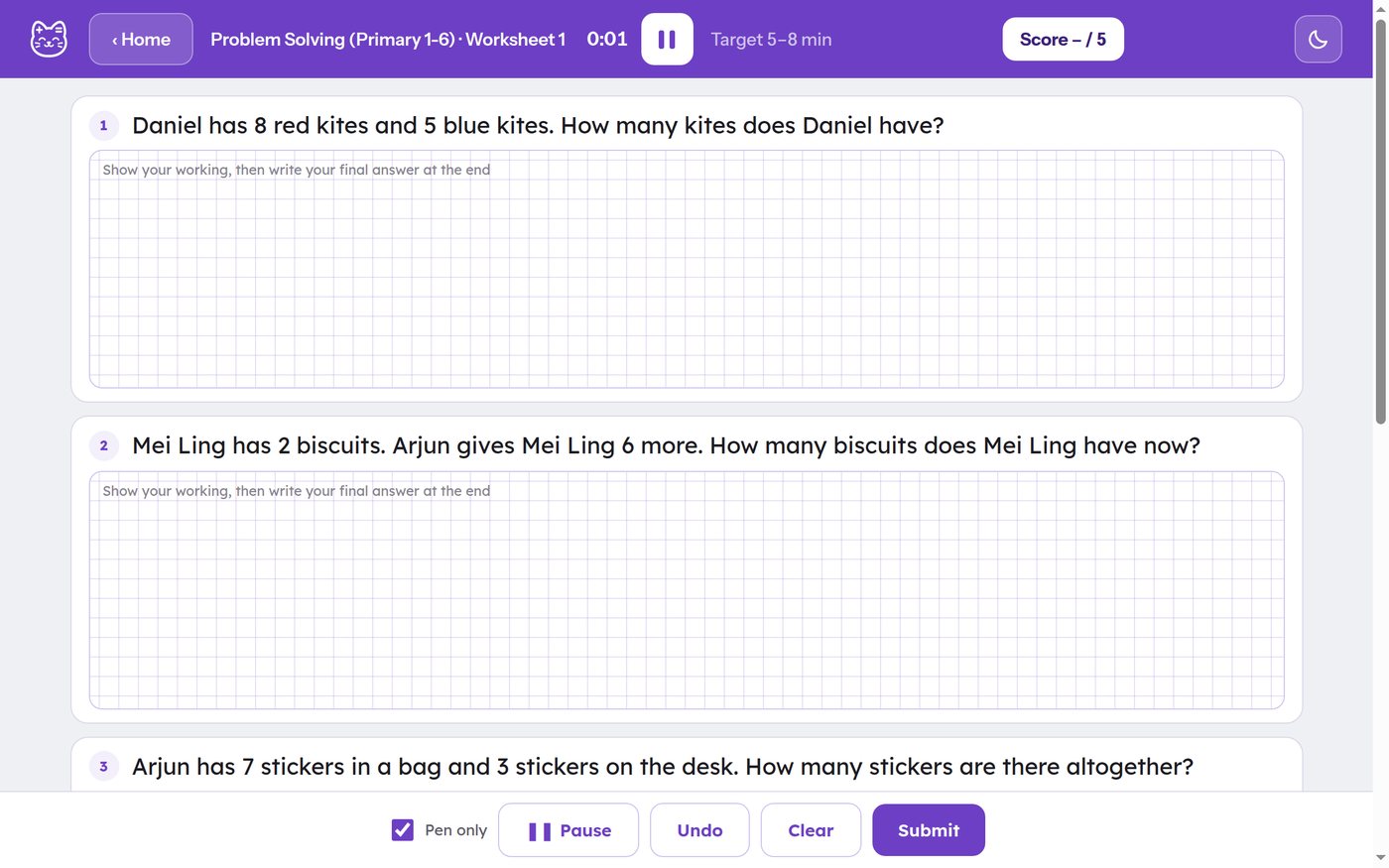
- Each worksheet has five questions. Each one is a short real-life problem with a single number as the answer.
- Your child writes the working in a big squared box and puts the final answer at the end, so every step has room.
- Only the final answer is marked. Mathhh reads the last answer and ignores the working and any units, so "RM6" and "6" are both fine.
- When an answer is wrong, a short list of steps appears beside the question, so the child can see the method and try again.
- The pass mark is 90%, which with five questions means all five right. A child who gets four can correct just the wrong one instead of repeating the sheet.
Using it at home
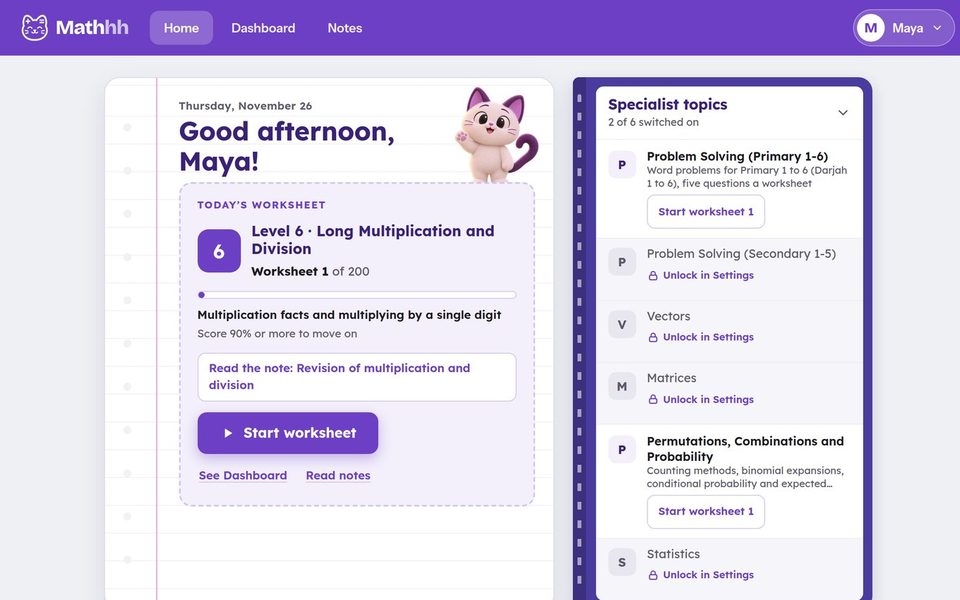
Problem Solving is open from the start, so there is nothing to switch on. On Home it has its own orange card, with a map of your child's current school year and its own Start worksheet button. It never moves your child's place on the main levels.
One Problem Solving worksheet a day alongside the usual one works well, for ten to fifteen minutes. With a younger child, sit beside them at first and ask them to tell you the story before they write anything. Writing by hand helps here too, because it makes children slow down and set out their steps. The other extra topics are in advanced topics, and secondary students have their own track. For a full example, see one Darjah 4 question solved line by line.
Questions people ask
Why do primary students find word problems hard?
A word problem asks a child to follow a story, choose an operation and then calculate. Many children are fine with the last step but have had little practice at the first two.
What is a good method for word problems?
Read it twice, underline the question, say what happens in your own words, write each step on its own line, and check that the answer makes sense in the story.
How many Problem Solving worksheets are there for Primary?
300 worksheets for Primary 1 to 6 (Darjah 1 to 6): 50 for each year, in ten topics of five worksheets.
How are Primary Problem Solving worksheets marked?
Each worksheet has five word problems. The child writes the working in a tall box and the final answer at the end. Mathhh marks only the final answer and shows how to solve any that were wrong.
Do I need to switch Problem Solving on?
No. It is open from the start. On Home it has its own orange card, with a map and a Start worksheet button.